Abstract
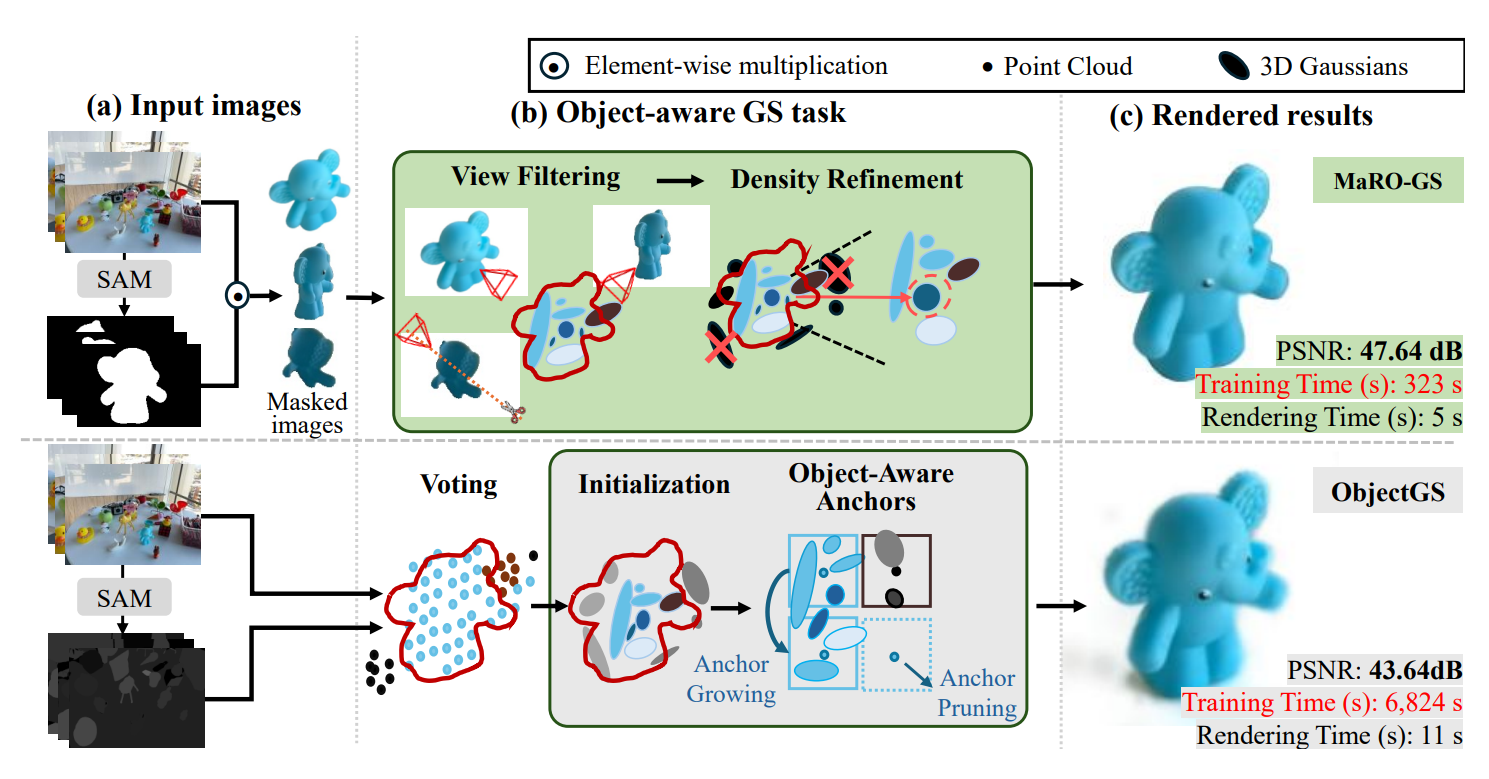
We address the challenge of accurate 3D object reconstruction from multi-view images in Gaussian Splatting. Existing object-level 3DGS methods reconstruct the entire scene rather than directly optimizing the target object, even when only the target object is needed, which incurs substantial computational overhead. They also rely on 2D segmentation masks to associate Gaussians with objects. Such inconsistencies corrupt Gaussian optimization and produce incorrectly supervised Gaussians that degrade object reconstruction fidelity. To overcome these limitations, we propose MaRO-GS, a 3DGS framework that directly optimizes target-object Gaussians from object-masked multi-view images and remains robust to inconsistent supervision. For reliable supervision, mask-reliability view filtering excludes unreliable views. Object-supported Gaussian density control suppresses Gaussians irrelevant to the target object and prevents background densification, while Silhouette-aligned Object Loss maintains object-focused optimization. Extensive experiments across diverse datasets demonstrate that MaRO-GS consistently improves reconstruction fidelity, segmentation accuracy, and computational efficiency, achieving up to 2.05 dB higher PSNR on the LERF-Mask dataset.
Method
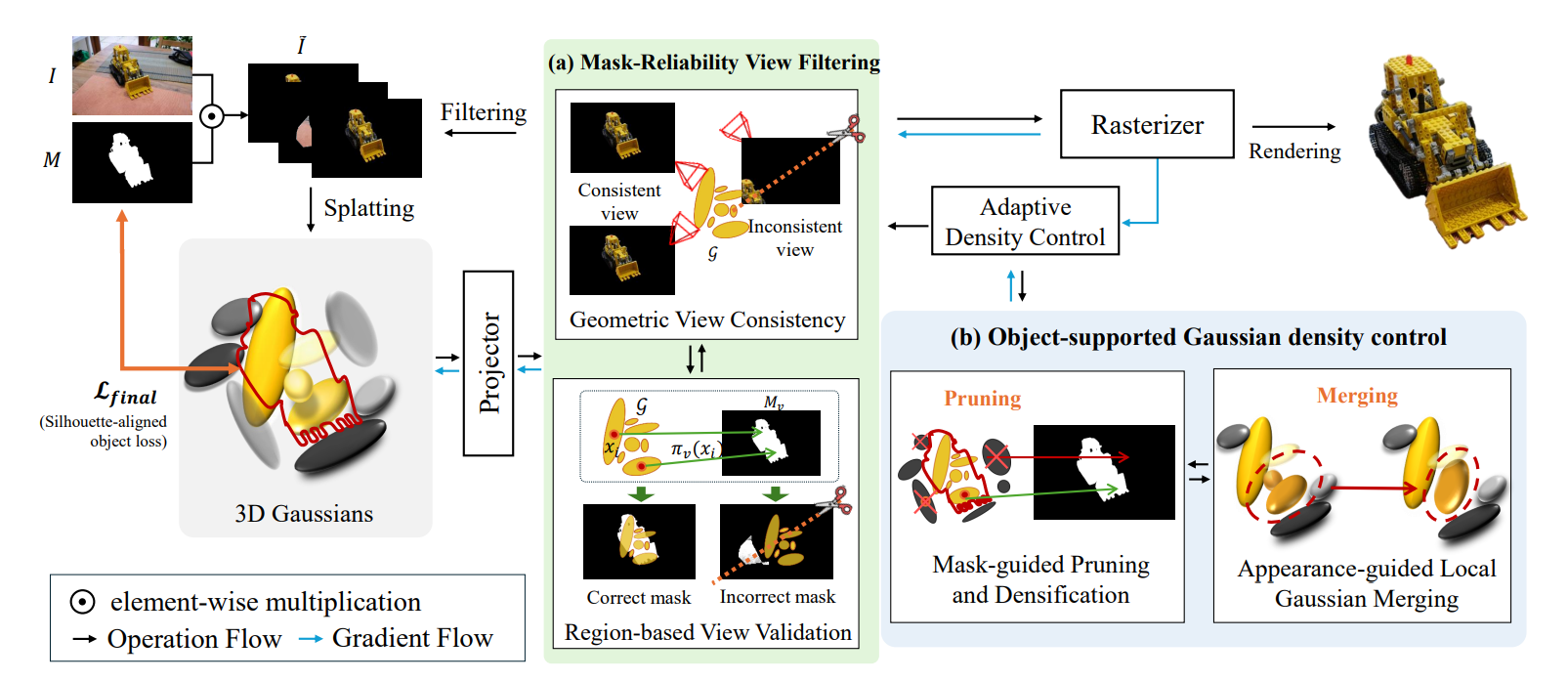
Figure 2: Overview of MaRO-GS for object-centric 3D Gaussian Splatting. The pipeline first removes inconsistent views through (a) mask-reliability view filtering. It then suppresses Gaussians irrelevant to the target object via (b) object-supported Gaussian density control to improve object reconstruction fidelity.
Quantitative Results
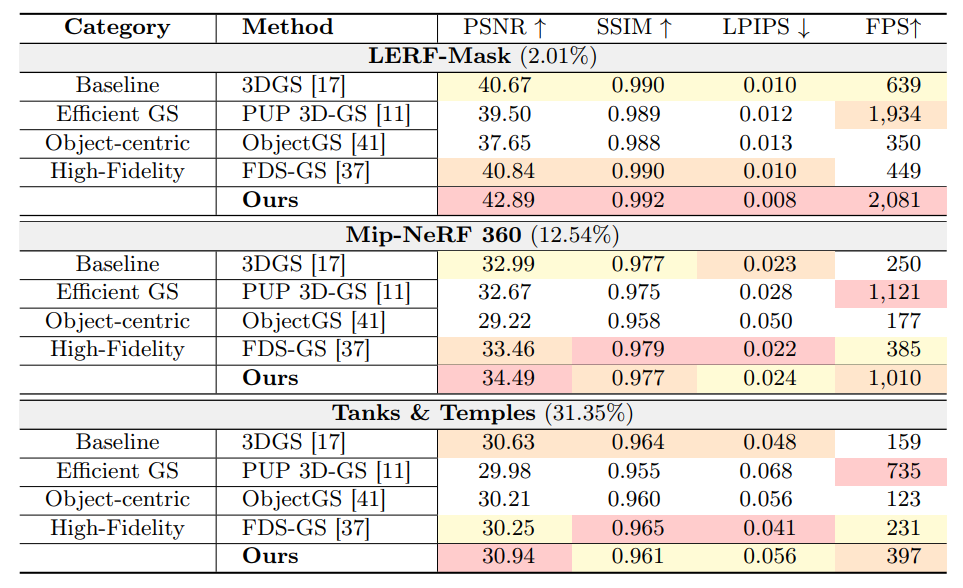
Table 1: Quantitative comparison on the LERF-Mask, Mip-NeRF 360 and Tanks and Temples. The percentages next to each dataset indicate the average object area ratio within the frame. The best, second-best, and third-best results are highlighted in red, orange, and yellow, respectively.
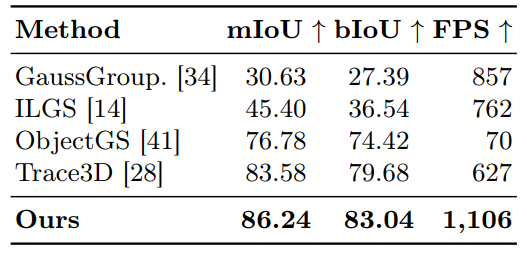
Table 2: Quantitative comparison of object boundary quality. Best results are highlighted in bold.
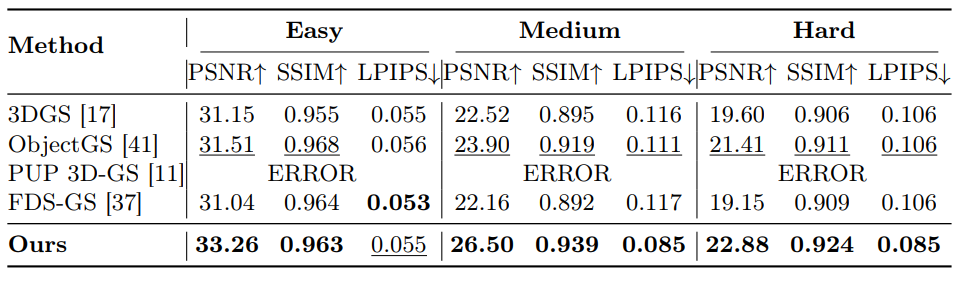
Table 3: Evaluation on the DTU [15] Dataset. Best results are highlighted in bold, and second-best results are underlined. PUP 3D-GS [11] fails to train because all Gaussians are pruned during training.
Qualitative Results
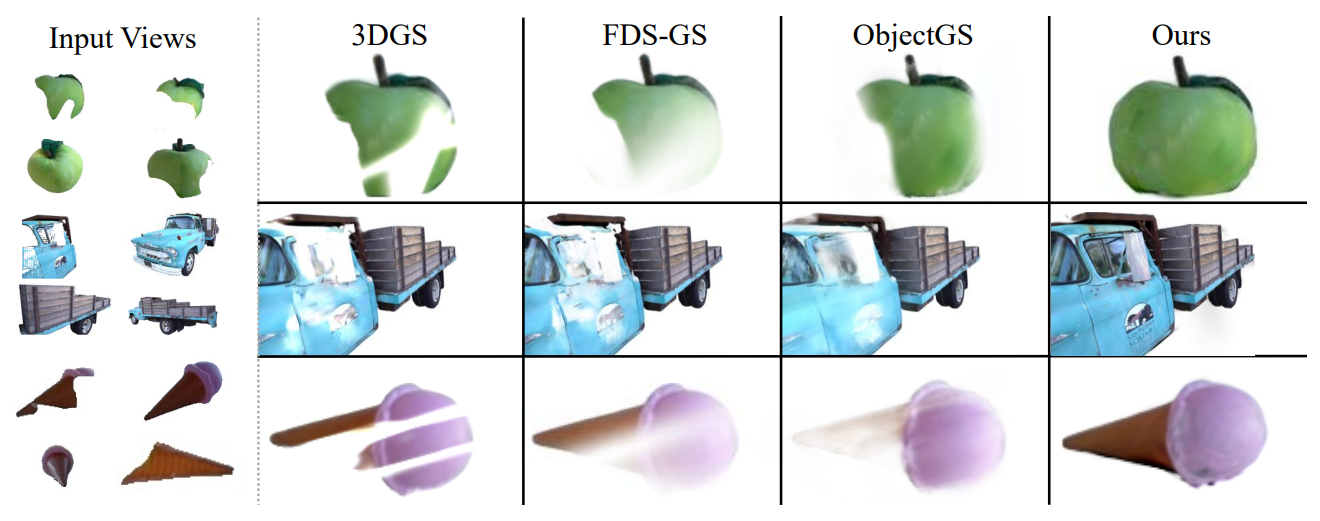
Figure 4: MaRO-GS reconstructs target objects from input views with inconsistent background removal. Existing approaches produce residual artifacts, whereas MaRO-GS achieves robust, high-fidelity object reconstruction.
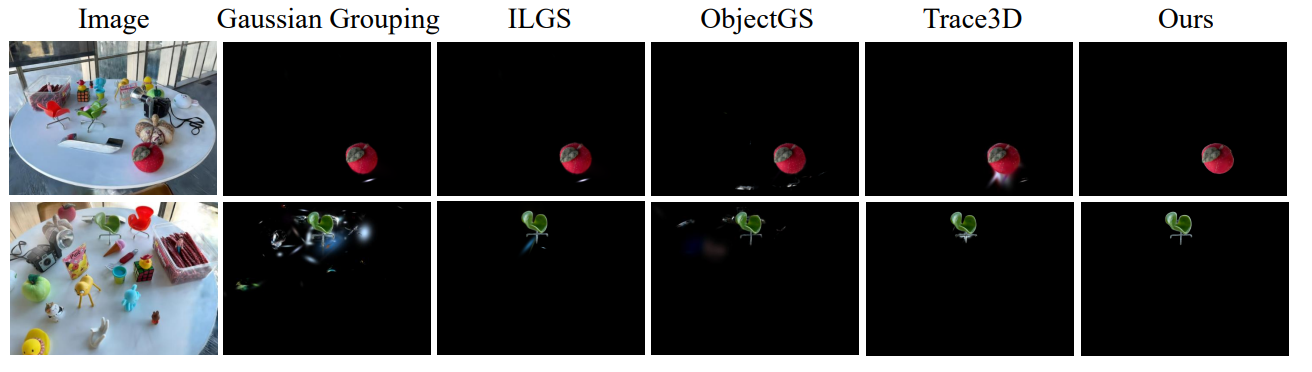
Figure 5: Qualitative comparison of our method with object extraction methods on the LERF-Mask dataset.
Video Presentation
BibTeX
@misc{kim2026marogs,
      title={MaRO-GS: Mask-Robust Object-Centric Gaussian Splatting from Inconsistent Multi-view Masks},
      author={Eunji Kim and Gahyeon Kim and Gianella Cravioto and Dong-hun Lee and Chaewon Moon and Chae-yeong Song and Sang-hyo Park},
      year={2026},
      eprint={2610.06472},
      archivePrefix={arXiv},
      primaryClass={cs.CV},
      url={https://arxiv.org/abs/2610.06472},
}@